
Social media posts cite real sunscreen absorption studies but go beyond what the research found
Some chemical sunscreen ingredients can be absorbed through the skin and detected in blood. That part of the claim is based on real studies by FDA researchers, published in JAMA in 2019 and 2020.
However, those studies did not show that sunscreen causes cancer, damages the immune system or removes the body's cancer defenses. The 2020 JAMA study explicitly stated that its findings did not mean people should stop using sunscreen.
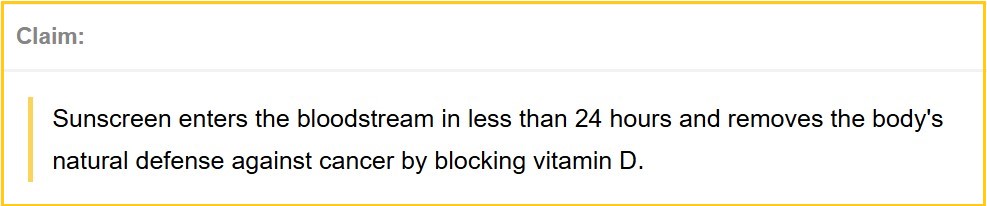
n June 2026, a claim circulated online that sunscreen enters the bloodstream in less than 24 hours and increases the risk of cancer by interfering with the body's natural defenses.
One Facebook post (archived) spreading the claim said:
SUNSCREEN ENTERS YOUR BLOODSTREAM IN UNDER 24 HOURS. THE FDA CONFIRMED THIS IN 2019. THEY DID NOT PULL A SINGLE PRODUCT. THEY TOLD YOU TO KEEP APPLYING.
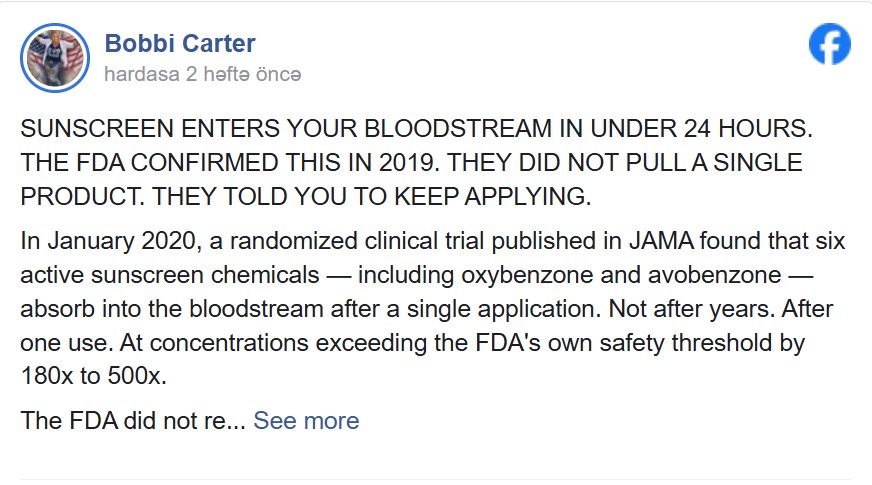
The post went on to claim that sunscreen blocks vitamin D, that vitamin D is the body's "single most critical regulator" against malignant cells and that sunscreen therefore "removed your defense" against cancer.
Versions of the same text circulated across Facebook, X and Telegram channels. Several versions included the same anonymous quote attributed to a "former formulation chemist" who allegedly worked for a "top-3 sunscreen manufacturer." (We found no evidence that the alleged chemist, the company involved or the "internal documents" existed.) Snopes readers also searched the website for variations of the claim.
In short, the social media claim contains a real finding but draws an unsupported conclusion from it.
Studies by U.S. Food and Drug Administration researchers, published in the peer-reviewed medical journal JAMA, found that several chemical sunscreen ingredients could be detected in blood after use. The agency has requested more safety data for some ingredients, but absorption is not proof of harm. The evidence does not show that sunscreen causes cancer or removes the body's natural defense against cancer. Health authorities continue to recommend sunscreen as one part of sun protection.
For those reasons, we rated this claim mostly false.
In an email to Snopes, the American Academy of Dermatology said there is "no evidence that sunscreen use causes cancer," while the science linking unprotected sun exposure to skin cancers, including basal cell carcinoma, squamous cell carcinoma and melanoma, is "well-established and long-standing."
Snopes contacted the FDA for comment and will update this story if we receive a response.
What the research found
Social media posts are partly based on real research. In 2019 and 2020, JAMA published studies that tested whether certain chemical sunscreen ingredients could be absorbed through the skin and detected in the bloodstream. Snopes previously examined a related claim about sunscreen chemicals and bloodstream absorption, concluding that absorption does not necessarily equate to risk.
The 2019 JAMA study tested four sunscreen ingredients — avobenzone, oxybenzone, octocrylene and ecamsule — under what researchers called "maximal use" conditions. The study found that all four ingredients were absorbed into the bloodstream.
The 2020 JAMA study tested four sunscreen products on 48 healthy adults. Researchers measured six active ingredients: avobenzone, oxybenzone, octocrylene, homosalate, octisalate and octinoxate. Under the study conditions, all six ingredients could be detected in participants' blood after sunscreen was applied. For all six, levels rose above 0.5 nanograms per millileter, an FDA threshold that can help determine whether more safety testing is needed. That happened after a single application on the first day of the study.
The study supports the limited claim that some sunscreen ingredients can enter the bloodstream in less than 24 hours. But the 0.5 ng/mL figure was not a "danger line," and the study did not find that the ingredients caused cancer or any other disease. The researchers said the findings showed a need for more research. The study itself stated: "These findings do not indicate that individuals should refrain from the use of sunscreen."
Did the FDA confirm this?
The FDA has acknowledged that some sunscreen ingredients can be absorbed through the skin and enter the body. But the agency has not said that absorption alone means those ingredients are unsafe.
In a 2020 FDA discussion of sunscreen, Terri Michele, then director of the FDA's Division of Nonprescription Drug Products, said that the fact that an ingredient is absorbed through the skin and into the body "does not mean that the ingredient is necessarily unsafe." She said the finding called for more testing to determine safety for repeated use, but that the public should continue to use broad-spectrum sunscreens with SPF 15 or higher along with other sun-protection measures.
The FDA has said zinc oxide and titanium dioxide had sufficient safety data to support proposed GRASE status, meaning "generally recognized as safe and effective." For several other sunscreen active ingredients, including avobenzone, oxybenzone, octocrylene, homosalate, octisalate and octinoxate, the FDA said additional data was needed. But the agency also said its request for more data did not mean those ingredients had been shown to be unsafe.
What about vitamin D?
Social media posts also argued that sunscreen increases cancer risk by blocking vitamin D production. Sunscreen can reduce exposure to UVB radiation, which helps the body produce vitamin D, but health authorities do not recommend intentional unprotected sun exposure as a cancer-prevention strategy.
The American Academy of Dermatology says there is no safe level of UV exposure from the sun or indoor tanning that allows maximum vitamin D production without increasing skin cancer risk. It recommends getting vitamin D from diet and supplements instead.
In response to the claim that sunscreen blocks vitamin D and therefore "removes" the body's cancer defenses, the academy told Snopes via email: "There is no strong evidence supporting the claim that sunscreen blocks vitamin D and removes the body's cancer defenses." It added that basing health decisions on poorly supported evidence is risky.
A 2019 review in the British Journal of Dermatology also found that sunscreen use for daily and recreational sun protection generally does not compromise vitamin D synthesis, even when applied under optimal conditions.
The National Cancer Institute says research on vitamin D and cancer has produced mixed results. It also says people should not try to increase vitamin D by increasing sun exposure, because doing so increases the risk of skin cancer.
What health authorities say about sunscreen
Public health guidance has not changed in response to the JAMA absorption studies. The Centers for Disease Control and Prevention says most skin cancers are caused by too much exposure to ultraviolet light, while the FDA says broad-spectrum sunscreens with SPF 15 or higher can reduce the risks of sunburn, skin cancer and early skin aging when used as directed with other sun-protection measures.
The American Academy of Dermatology told Snopes that it recommends a comprehensive sun-protection plan: "seeking shade, wearing protective clothing, and applying a broad-spectrum, water-resistant sunscreen with an SPF of 30 or higher to all skin not covered by clothing."
The American Academy of Dermatology similarly says current science does not show that sunscreen ingredients currently available in the U.S. are harmful to human health. Stanford Medicine's 2025 explainer also said scientific studies have consistently shown that regular sunscreen use reduces the incidence of skin cancer and slows signs of aging.
The bottom line
Some chemical sunscreen ingredients can enter the bloodstream, and studies by FDA researchers found that six active ingredients exceeded a threshold used to decide whether additional safety studies may be needed.
But the social media posts making the claim went far beyond the evidence. The JAMA studies did not show that sunscreen causes cancer, and the FDA did not say sunscreen removes the body's defenses. The American Academy of Dermatology told Snopes there is no evidence sunscreen use causes cancer and no strong evidence that sunscreen blocks vitamin D in a way that removes the body's cancer defenses.
Health authorities continue to recommend sunscreen as part of a broader sun-protection strategy that includes shade, protective clothing and avoiding excessive UV exposure.